
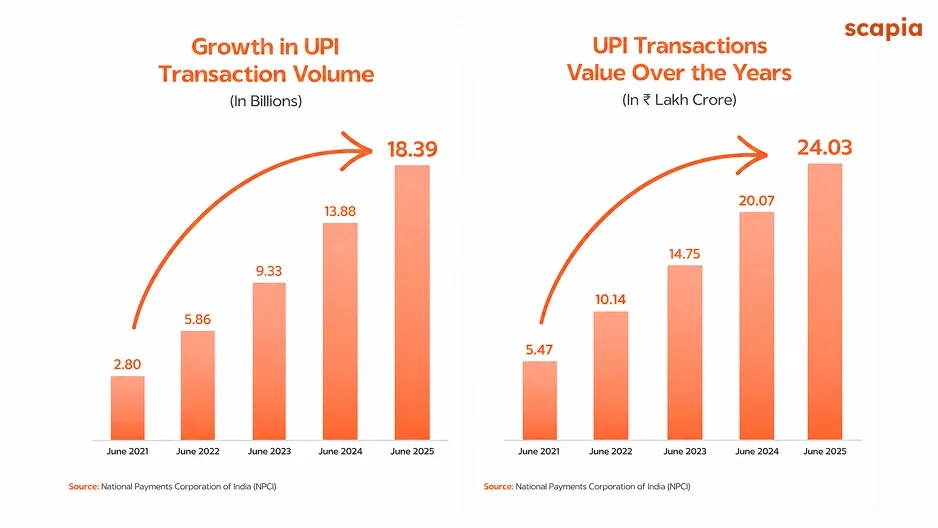
Think about the transactions you made through the week. It’s likely that most of your payments were done via UPI. Afterall, 85% of all digital transactions today are UPI transactions.
Ever since UPI launched a decade ago, the tailwinds behind it have only grown stronger. Transactions, in both volume and value, have grown at breakneck speed year on year.
And then, UPI was enabled on RuPay. It meant India had a new way to use UPI. With a credit card.
At Scapia, we were looking for a way to make everyday spending add to travel opportunities. The UPI-on-credit opportunity was a perfect fit. It meant users could use their credit cards for their daily transactions in a way preferred – enabling them to accumulate Scapia Coins for their travel.
That is how Scapia’s Dual Line Credit Card came to be.
This is how Team Scapia made it happen:
The opportunity: Kya aapke card mein UPI hai?
Scapia is built on one idea: the money you already spend should bring your next trip closer. Every eligible rupee on the card earns rewards toward travel.
At the time, our card ran on Visa, which users could use online and at any merchant with a card machine. But we were missing out on smaller transactions – the ones in kiranas, food stalls, and at the vegetable vendors’. So the rewards only kicked in on a fraction of what a customer actually spent. The everyday spending that had already moved to UPI earned them nothing toward a trip.
We wanted Scapia to show up at the everyday payment, the way our customers preferred to pay. That meant being on UPI.
People were already carrying two Cards: One RuPay, which they used on UPI for their regular use; and the other, a card for larger or online purchases. The two did not compete. A second card sat beside the first and picked up the spends the first one could not reach.
But carrying more than one card has a cost that rarely gets named. Each card brings its own statement, its own due date, its own payment to remember. Tracking your spending gets harder with every card you add, even when one credit line sits under all of them. People were managing that friction themselves because no product had removed it for them.
The solution: A Second Card That Adds Nothing to Manage
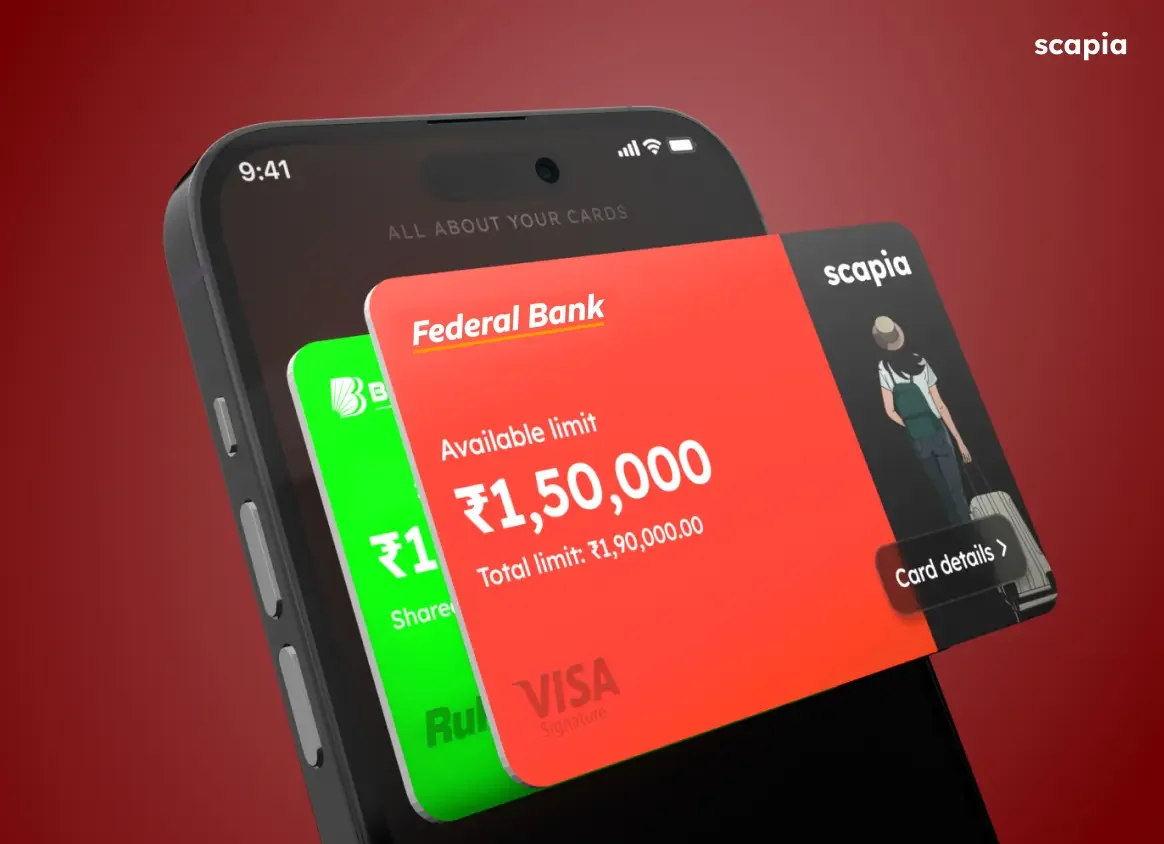
We did not want to hand customers a second card and call it a feature. Instead, we wanted to give our cardholders a second card without the extra layers of adding anything they had to manage.
The solution? A shared credit line and two cards that run on a network each: Visa (our existing network partner) and RuPay from one shared credit line. Spend on either card and your available limit moves together. At the end of the month there is one statement and one payment, in the same app you already use. Smart filters show your Visa and RuPay spends separately if you want them, and if you don't, your routine stays the same.
That consolidation was the hard part to get right, and the part we are proudest of.
Scapia was among the first in India to offer a dual-line card, and the first in the industry to put both cards on a single statement. Getting more did not mean managing more.
But what about Rewards?
The market had seen UPI rewards before us. Years of UPI cashback had worn thin, and people had little patience left for small rewards scattered across apps. But Scapia Coins were an essential piece of the Scapia ecosystem – spends were meant to add up to a trip rather than a one-off discount.
So here’s how Scapia Coins now work with RuPay Payments: Eligible spends earn 5% back in Scapia Coins, where 5 coins are worth ₹1. The reward is aimed at everyday, recurring spending and turns it into steady progress toward your next trip.
The Challenge: Keeping it Simple with One Single Statement!
It was easy to say, but hard to build: two networks, one credit line, and one statement.
We were clear on this principle from the start. While cardholders may, in principle, have two cards, they should never feel like they are managing two accounts. So the Dual-Line Card was built around a single consolidated statement. One due date, one payment at the end of the month, in the same app you already use.
The part we obsessed over was how cardholders move through it. So, here’s how we built it: RuPay and Visa spends sit together as one balance. A single toggle pulls them apart whenever you want a closer look. Tap to see only your RuPay spends for the month, tap again for Visa, and your total stays one clean number the whole time. The layout stays familiar throughout, so nothing about your routine changes.
This had not been done in India before. On other cards, more than one card on the same credit line still meant separate statements and separate payments to keep track of. We were the first in the industry to bring both cards onto one statement, so a second card never turned into a second thing to reconcile.
Where We Are Now
What launched as an experiment is now the default. A RuPay card comes built into the Scapia Federal Credit Card. The clearest proof that this matched how people actually pay: the RuPay card now drives the majority of transactions on Scapia by volume. The everyday spends we set out to capture turned out to be most of the spending.
From one statement to a full UPI stack, every step has come back to the same goal of meeting people where they already spend.
That is what the Dual-Line Card is built for: the way India actually pays.
Scapia is now a complete payments ecosystem in itself. We have also built our own full-stack UPI payments feature, Scapia Pay, where the Scapia RuPay Card is the default way to pay. This, along with the enablement of BBPS for credit card bill payment completes the entire financial services loop – of borrowing, payments, and repayment of your finances.